Crossing the Rubicon is the key step in the ZRM process. Once you have crossed it, you are ready to put your intention into action.

Picture taken by Quang Nguyen Vinh (pexels.com)
When you have decided to change one of your habits, for example to do more physical activity or to defend your point of view more often, you have probably noticed that it is not always that easy. What needs to happen so that you can implement your resolutions?
In the early 1990s, the Institute of Education at the University of Zurich hired two psychologists, Maja Storch and Frank Krause. Their mission was to develop a self-management method for teachers. To accomplish this task, they first turned to existing theories of motivation.
The Rubicon Model
In the 1980s, two motivational psychologists, Heinz Heckhausen and Peter M. Gollwitzer, wondered what needed to happen for a person to move from wishing to acting. They identified four steps to achieve this. There are probably many personal projects you would like to accomplish. At the same time, you realize that you only end up accomplishing some of them. So, merely wanting to carry out a certain action is not enough.
According to these two psychologists, before you actually take action, you evaluate your options and weigh the pros and cons of the different alternatives. At this stage, you are not yet able to make a decision. Something has to happen before you can make up your mind and take action. You have to truly “cross the Rubicon.” The two psychologists were inspired by this expression and named their theory the “Rubicon model.” Where does this expression come from?
Caesar at the Rubicon
The Rubicon is a river in northern Italy. In 49 BC, Julius Caesar stood on the banks of the Rubicon and pondered what to do. He had just returned from a successful military campaign with his army and was expected in Rome. Around Rome, there was a demilitarized zone that no army was allowed to enter, and the river marked the boundary of this zone. So he stood there, wondering whether he should defy this directive and attack Rome to seize power. He knew that the consequences of such an action would be serious and could cost him his life.
It took him some time to weigh up his options. But at a certain point, his decision was made and he exclaimed “alea iacta est,” which means “the die is cast.” Once he had crossed the Rubicon, Caesar could not turn back. He had to follow through with his plan.
The Rubicon has become a symbol of the moment when you can no longer look back, but only move forward. You have reached the “point of no return.”
The Rubicon in everyday life
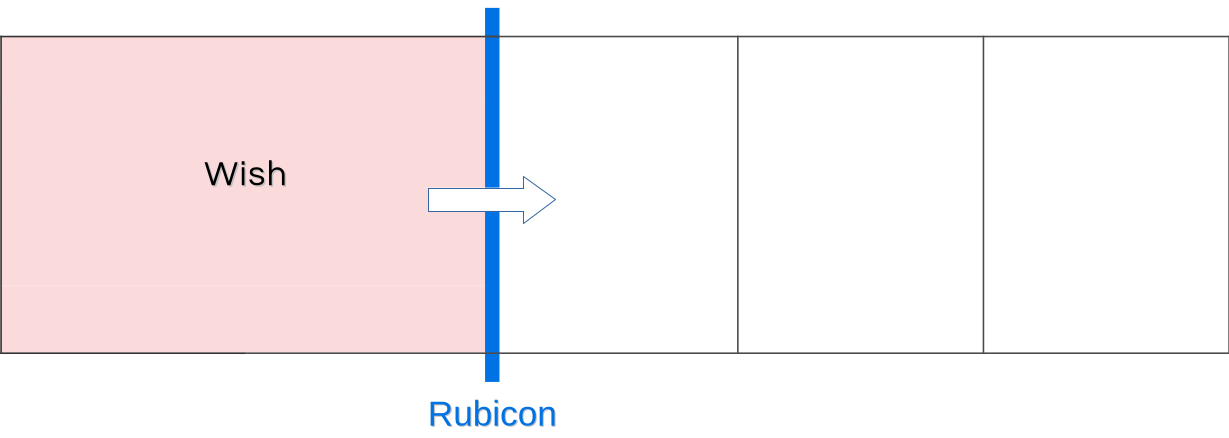
Before crossing the Rubicon, a weighing process takes place. You gather information, consider the pros and cons, do research, and ask other people for their opinions. You are torn between the different options. At this stage, you might say things like, “I would like to...,” “I wish I could...,” or “I want to...”. The wish is expressed, but the determination is weak.
Think about a big decision you've made in your life, like getting married, buying a house, or taking a new job. When you think about it, you may realize how hard it was. You were probably weighing up the different options. There were doubts and fears about making the wrong decision. And at some point, everything became clear and you made your decision. In doing so, you crossed the Rubicon. Turning back became impossible. You were completely determined.
Exploring the unconscious need
When developing their self-management method, the two psychologists at the University of Zurich based their work on the Rubicon model mentioned above. However, they were well aware that our behavior is not solely driven by reason, as there are two systems at work in our brains. The unconscious system, which aims to ensure your well-being, plays an essential role in implementing your decisions. If your unconscious disagrees with an intention, it will sabotage it in subtle or very direct ways and effectively prevent you from carrying it out.
For example, telling yourself that you want to better defend your needs and say no more often is not enough to actually do so. If, on a unconscious level, you have a strong need to be in harmony with others, you will find it hard to refuse their requests. In order to get your unconscious to agree to a personal project, you need to examine your unconscious and seek its support. The approach of the two psychologists in Zurich therefore begins with exploring the unconscious need.
As long as you don't take your unconscious needs into account, they can easily compromise your plans. To better understand them, it's best to stop overthinking and instead pay attention to your somatic markers and emotions, which can guide you toward the right decision.
Your unconscious need and your conscious desire must first be aligned. This means that you need not only a “mental yes”, but also a “felt yes” in order to implement your intention.
Beyond the Rubicon
Once you've crossed the Rubicon, your mindset changes completely. Doubts and uncertainty disappear, giving way to determination and optimism that drive you forward. Now that you've made your decision, you won't let new arguments throw you off course. This is the point of no return, as it was for Caesar. Finally, you've reached the point where you can act according to your intentions.
In the best-case scenario, your determination is sufficient to achieve your goal directly. For me, this was the case when I decided to train in the field of coaching. The day after making this decision, I started looking for information about existing training courses, without questioning my decision or allowing myself to be distracted. After that, I committed myself 100% to this goal.
Unfortunately, your old habits may get in the way. Furthermore, under pressure and stress, you may fall back into old patterns of behavior that you no longer want. This may also happen when you are caught off guard by a situation. Even though your decision is set in stone, your automatic reactions may prevent you from adopting the new behavior immediately and in all circumstances. In such cases, you need an extra step to properly prepare your action.
The Rubicon Process in the ZRM
The psychologists Maja Storch and Frank Krause developed the ZRM® (Zurich Resource Model) self-management method, which is based on a modified Rubicon model. They call it the “Rubicon Process” and it consists of five steps:
- Need (unconscious)
- Wish (conscious)
- Determination (firm intention)
- Preparing for action
- Action
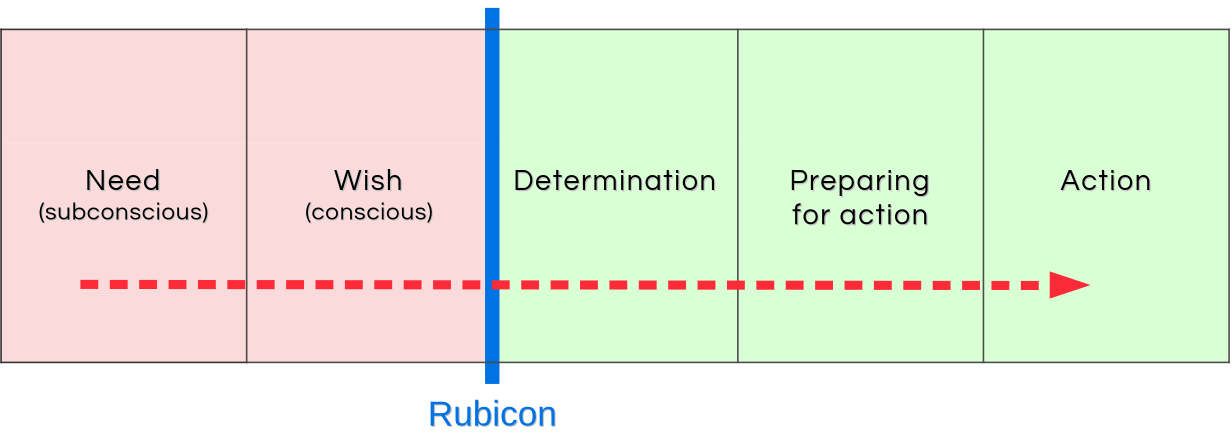
The Rubicon is located between the second and third stages. To cross it, one's needs and wish need to be aligned and directed toward the same goal. To this end, ZRM invites the person to search for images that evoke strong positive feelings. The images they choose enable them to obtain their unconscious's view regarding their wish. Based on the elements they find relevant in these images, they then define an attitude goal, which they formulate in the form of a motto. As a result, this motto goal will be supported by both systems of the brain, and the person will be able to cross the Rubicon.
ZRM self-management workshops
You can learn to move through this process yourself in a ZRM self-management workshop. Through the alignment of unconscious and conscious motives, you will gain a level of determination you did not possess previously. After this step, you can either immediately put your clear and firm intention into practice (step five) or you require another step to prepare for action. This fourth step is necessary when strong old habits prevent you from acting according to your motto goal. With the help of ZRM tools, you will find the means and resources that will support you in your efforts to act as often as possible according to the attitude expressed by your motto goal. Finally, you will be able to act in the way you wish in your daily lives.
By traveling through the Rubicon process, you will quickly see encouraging results with little effort. The basic principle is that the appropriate attitude must first be defined and activated before being able to take action. To do this, choosing images and creating a motto goal is essential and helps you cross the intrapsychic Rubicon. Even after crossing the Rubicon, it can sometimes take a few months for the new behavior to permanently replace your old habits, even when under stress and pressure. Your motto goal, however, will provide the determination for long-term success.
Willpower does not guarantee success
The Rubicon model clearly demonstrates that it is not enough to WANT to do something. Unless you have crossed the Rubicon, you lack the determination necessary to get started and follow through to the end. It is important to recognize that WANTING does not mean BEING ABLE. If someone tells you they want to start exercising, it is by no means certain that they will get started and stick with it. After all, that person's unconscious had its reasons for refraining from exercise until now. Even if their rational mind now tells them that physical activity is beneficial, their unconscious will not necessarily support that decision.
Your unconscious has a say in the matter and can easily compromise all your resolutions. Being aware of this fact will help you become more realistic – and abandon resolutions that don't suit you. Furthermore, this knowledge will enable you to find smart ways to succeed.
You may imagine your unconscious as a small child within you who seeks pleasure and lacks clarity about the future consequences of their actions. Think about how you could get their agreement. Abstract and theoretical arguments will never work. Your unconscious needs positive and concrete images to support your project. So you need to look for the enjoyable aspects, and perhaps proceed in small steps.
To this end, the ZRM method allows people to choose images and create their own motto goal so that they can cross their Rubicon. In Geneva, I regularly organize workshops where participants can discover this method. In addition, I rely mainly on the Rubicon process in my coaching of young people and adults.
Verve and ease after crossing the Rubicon
When you are optimistic and enthusiastic about your personal project, you have crossed the Rubicon and can move forward. The most critical step has been taken, even if, in some cases, additional means will be necessary to overcome your old habits and finally replace them with your new way of acting. Go ahead!
ZRM workshops: Those who wish to learn about the Rubicon process can participate in a ZRM self-management workshop. In Geneva, our institute is the only one to offer regular ZRM workshops – only in French so far. Find out more:
If you don't want to wait for the next workshop, our self-management coaching will give you the tools you need to better cope with everyday challenges.
Our article on the two systems in your brain:
Main source (only in German):
- STORCH, Maja, KRAUSE, Frank et WEBER, Julia, 2022. Selbstmanagement – ressourcenorientiert: Theoretische Grundlagen und Trainingsmanual für die Arbeit mit dem Zürcher Ressourcen Modell (ZRM®). 7. überarbeitete Auflage. Bern : Hogrefe. ISBN 978-3-456-86214-9
This article was first published in French in November 2024 and has now been translated into English by the author himself.
Author of the article: Beát Edelmann, expert in neurodiversity (autism, ADHD and high IQ) and personality exploration. He is the founder of the Abundana Institute for Self-Management in Geneva, which offers coaching, training, and consulting services in French, English, and German.
Articles about similar topic: ZRM
